Day 19
Friday, May 3
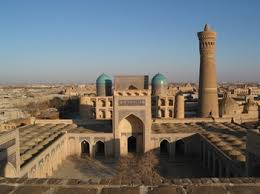
BUKHARA Begin your explorations of Bukhara by walking a
very short distance north of your hotel to Labi Hauz, a large pool lined with
very old mulberry trees and a perfect spot to have some tea. On one end of the
pool is a khanaqa and on the other is a madrasa—both named for Nadir Divanbegi,
finance minister under Khan Abdul Aziz in the 17th century. Note the unusual
images of herons and a sun with a human face on the madrasa’s portal; Abdul
Aziz was a Shi’ite in a heavily dominant Sunni neighborhood and was less
influenced by the usual interpretation of the Koranic injunction against
portrayal of the human or animal form.
Continue walking to the
Ulug Bek Madrasa, one of the oldest theological colleges in the country and one
of three commissioned by Ulug Bek, Tamerlane's grandson, and Abdul Aziz Khan
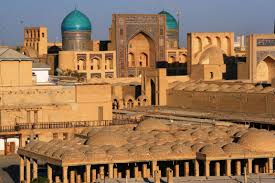
Madrasa, one of the last to be built in Bukhara. Continue to the Kalan Mosque,
formerly the Congregational Mosque, and its nearby 12th-century Kalan Minaret,
the most impressive minaret in Central Asia. Opposite is the 16th-century Mir-i-Arab
Madrasa which was closed n 1920 in keeping with official Soviet policy but
which like other religious institutions in the Soviet Union was opened by
Stalin in 1941, when he needed to get the population behind him during WWII.
Following lunch this
afternoon, visit the Arg which houses the 17th-century Friday
Mosque. (Please note: in early 2012, a
portion of the Arg’s massive outer wall collapsed, and at the time of writing,
the area remains closed until they are able to accurately decipher the cause.)
Just behind the Arg is a fantastic Zindon that remained in use until relatively
recent times and still provides visitors with a fascinating glimpse of what
life in a prison would have been like in the Middle Ages. From here, walk to
the Bolo Hauz Mosque with its exquisitely renovated ceiling panels, formerly
used by the Khans for Friday prayers. Continue on foot to the mausoleum of
Ismail Samanidon—one of the best examples of Samanid architecture, and the
nearby Chasma Ayub.


No comments:
Post a Comment