Day 16
Tuesday, April 30
TASHKENT
● DRIVE TO SAMARKAND
This
morning you’ll head out for Samarkand. "For lust of knowing what should
not be known, we take the “Golden Road to Samarkand," wrote James Elroy
Flecker. You’ll follow that road to Samarkand, and soon understand what Flecker
was getting at. Samarkand is a relatively up-to-date Uzbek city, but it still
vibrates with antique intensity. Even Alexander the Great who conquered the
city in 329 BCE said then that it was more beautiful than he had imagined.
Known as Maracanda to the Greeks, the city was founded sometime in the 5th
century BCE and was the center of the Sogdian Empire. The drive today is
approximately five hours.
It grew as a city of importance under all the
Central Asian invaders until it was destroyed by Genghis Khan in the 13th
century. However unlike other cities destroyed by that most devastating of
marauders which never regained past glory, Samarkand revived like the
proverbial phoenix in the aftermath of invasion. In fact, Samarkand became
greater than ever, most spectacularly under a descendant of Genghis named Timur
Leng or Timur the Lame, and his grandson Ulug Beg. What stands in the city
today dates back to their time.
This afternoon you’ll
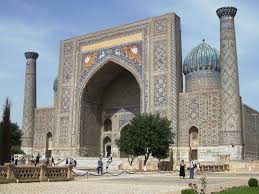
visit the Registan, called by British Imperialist Lord Curzon, the
"noblest public square in the world." Like the temple of Karnak at
Luxor or Angkor Wat in Cambodia, Samarkand’s Registan with its shimmering azure
and cobalt mosaics, its dazzling calligraphy and its monumental portals elicits
a certain breathlessness no matter how many times it is seen. The square is anchored to the west by the Ulug
Beg Madrasa, to the east by Shir Doh Madrasa, and to the north by Tila Kari.asa.


No comments:
Post a Comment